
Deux complexes pyramidaux auraient été découverts en Egypte, selon un visionnage satellite sur Google Earth.
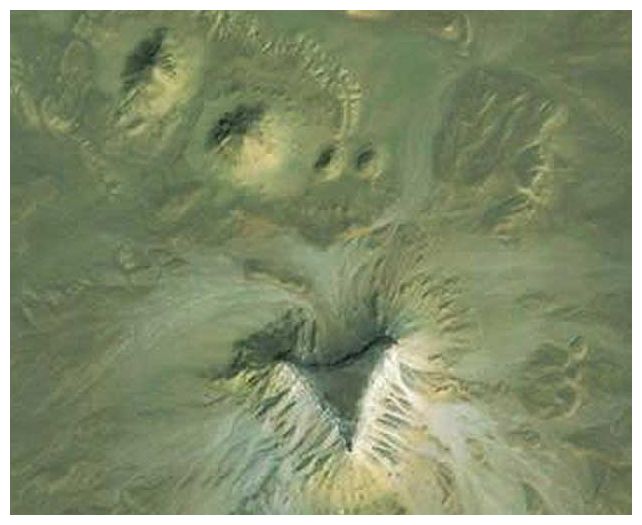
Angela Micol de Maiden, archéologue de l’université de Caroline du Nord révèle que les deux sites, en Haute-Egypte, à environ 7,5 kilomètres de la ville d'Abu Sidhum le long du Nil, disposent de quatre monticules de forme triangulaire chacun dont l’un domine les autres,
Les monticules feraient entre 100 pieds et 250 pieds de largeur.
Le complexe est disposé dans une formation très claire avec le grand monticule s'étendant sur une largeur de 620 pieds environ, près de trois fois la taille de la Grande Pyramide !
"Un examen plus approfondi de la formation, montre que ce monticule semble avoir un sommet très plat et une forme curieusement triangulaire, symétrique, fortement érodée avec le temps,"
Plus d’infos sur des anomalies de Google Earth. *
Si cette découverte est confirmée, quel chamboulement !
Source: Discovery news (A lire ci-dessous)
Joseph Kirchner pour WikiStrike
Lost Egyptian Pyramids Found?
In english
© Angela Micol
The site near Abu Sidhum contains four mounds with a larger, triangular-shaped plateau.
The site near Abu Sidhum contains four mounds with a larger, triangular-shaped plateau.
One site in Upper Egypt, just 12 miles from the city of Abu Sidhum along the Nile, features four mounds each with a larger, triangular-shaped plateau.
The two larger mounds at this site are approximately 250 feet in width, with two smaller mounds approximately 100 feet in width.
The site complex is arranged in a very clear formation with the large mound extending a width of approximately 620 feet -- almost three times the size of the Great Pyramid.
"Upon closer examination of the formation, this mound appears to have a very flat top and a curiously symmetrical triangular shape that has been heavily eroded with time," Micol wrote in her website Google Earth Anomalies.
Intriguingly, when zooming in on the top of the triangular formation, two circular, 20-foot-wide features appear almost in the very center of the triangle.
© Angela Micol
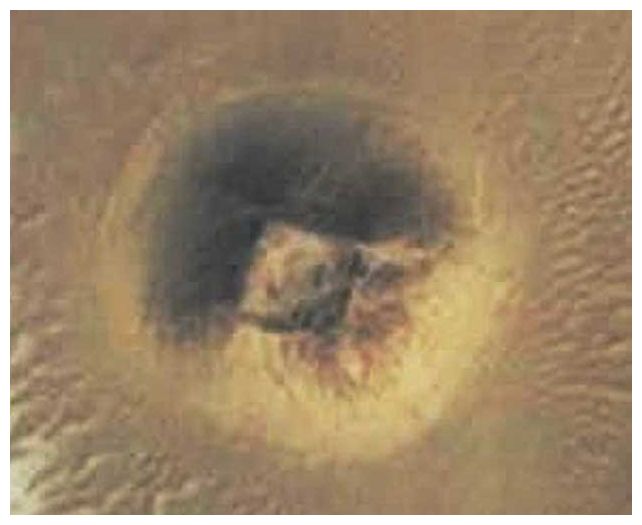
Enhanced image of the 150 foot wide, four-sided mound near the ancient town of Dimai.
Enhanced image of the 150 foot wide, four-sided mound near the ancient town of Dimai.
"It has a distinct square center which is very unusual for a mound of this size and it almost seems pyramidal when seen from above," Micol wrote.
Located just 1.5 miles south east of the ancient town of Dimai, the site also contains three smaller mounds in a very clear formation, "similar to the diagonal alignment of the Giza Plateau pyramids," Micol stated in a press release.
"The color of the mounds is dark and similar to the material composition of Dimai's walls which are made of mudbrick and stone," the researcher wrote.
Founded in the third century B.C. under the Ptolemaic king Ptolemy II Philadelphus (309 B.C. - 246 B.C.), Dimai was built on top of an earlier neolithic settlement.
Also known as Dimeh al-Siba, Dimeh of the Lions, the town is surrounded by a mudbrick wall that stretches up to 32 feet high and 16 feet thick, and features at its center a ruined stone temple dedicated to the crocodile god Soknopaios.
Indeed, the town's Greek name, Soknopaiou Nesos, means "Island of Soknopaios."

© Angela Micol
The site also contains three smaller mounds in a formation similar to the diagonal alignment of the Giza Plateau pyramids.
The site also contains three smaller mounds in a formation similar to the diagonal alignment of the Giza Plateau pyramids.
According to Micol, both sites have been verified as undiscovered by Egyptologist and pyramid expert Nabil Selim, whose findings include the pyramid called Sinki at Abydos and the Dry Moat surrounding the Step pyramid complex at Saqqara.
Selim found that the smaller 100-foot mounds at the site near Abu Sidhum are a similar size as the 13th Dynasty Egyptian pyramids, if a square base can be discovered.
"The images speak for themselves. It's very obvious what the sites may contain but field research is needed to verify they are, in fact, pyramids," Micol said.
The researcher has previously located several possible archaeological sites with Google Earth, including a potential underwater city off the coast of the Yucatan peninsula.
She believes the use of infrared imagery will allow scientists to see the extent of the complexes in greater detail.
The sites have been sent to Egyptologists and researchers for further investigation and "ground truthing," she said

Aucun commentaire:
Enregistrer un commentaire